

The Volkswagen Beetle is an un-mistakable icon in the car industry. Since its first production in 1937 in war turn Germany, it has become a pop-culture symbol. We all remember playing “punch buggie” with sore arms as children. The Beetle even starred as “Herbie” in Herbie the Love Bug.
The early years of the Volkswagen Beetle are surrounded by controversy. Some believe that the car was originally designed by Jewish engineer Josef Ganz, one historian even found images of him driving a prototype of his design. It is said that Hitler saw the car designed by Josef Ganz at a 1933 car show. However, it is known that Hitler did present legendary car designer Ferdinand Porsche with sketches for a car he believed would become the “People’s Car”. His design called for a car that would have seating for four people, a rear engine, and would be priced at no more than 1,000 Reichsmarks, the exact amount that Josef Ganz said the car would cost.
By 1934 the initial design had been changed to create a car that could carry two adults and up to three children and be able to travel at speeds of up to 100 km/h. At the same time this car would need to be able to attain a fuel economy rating of not more than 7 liters per 100 km, which equates to 32 mpg.
Through the Ages
Economical Design.
The vehicle was designed with the thought in mind that as parts wore out they could be replaced easily and inexpensively. The cornerstone for the first Volkswagen factory was laid in 1938 in Fallersleben. By the outbreak of war in 1939 the company had only produced a few hundred cars at which time production was converted to military vehicles. Despite this, a number of Beetle models were produced for the Nazi elite during the years 1941 through 1945.
After the Second World War the Allies limited production in German factories with the VW factory limited to producing 1,000 cars per month. The first VW Beetle Type 1’s were produced in 1945 with a total production of 1,785 cars. Production increased significantly until the one millionth Beetle came off the production line in 1955. These models had a top speed of 115 km/h and a fuel efficiency rating of 36 mpg.
The Fifties and Change
The Golden Age.
During the 1950s the Type 1 underwent a number of significant changes including replacing the twin oval rear windows with a single piece of glass. By 1957 the size of this window was increased to cover the full width of the rear end. Changes continued throughout the sixties with taller side windows and a taller slightly curved windshield. In 1966 the 1200 c.c. engine was upgraded to 1300 c.c.
By 1972 Volkswagen Beetle production reached 15,007,034 cars a number that surpassed the previous record holder, the Model T Ford. The Super Beetle was first introduced in 1972 and continued to be produced with a number of modifications and variants throughout the 1970s. However the introduction of a number of U.S. based small cars began to eat into the market along with a number of liquid cooled Japanese vehicles.
Even Volkswagen themselves introduced another vehicle to the market, the front-wheel drive Golf. While this vehicle did replace the Beetle in the U.S., production continued in many other countries well into the 1980s and beyond. The final type 1 Beetle rolled off the production line in Puebla, Mexico on the 30th of July in 2003. After 65 years of production a total of 21,529,464 Type 1 Beetle models had been produced.
The New Generation
The Beetle Returns.
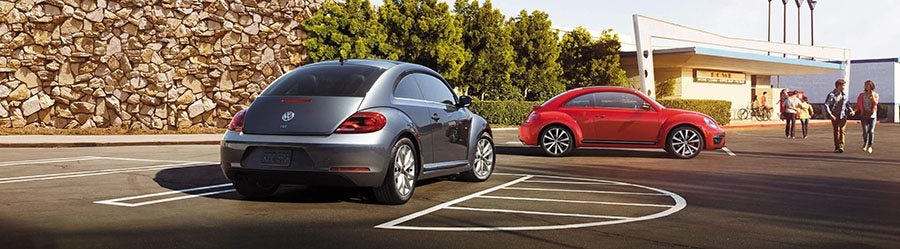
Call it nostalgia or simply the desire for a cute car reminiscent of the original Beetle, the first of the new generation of Volkswagen Beetle models were introduced to the world in 1997. While the new version draws heavily on the design of the original model, the new Beetle offers a front wheel drive version that is powered by a liquid cooled engine mounted in the front of the car instead of the rear. The public reaction to this great little car has been nothing short of amazing as it has risen to become one of the most popular and affordable small cars on the U.S. market.
See all that the “New” Volkswagen Beetle has to offer at Capital Volkswagen, we are conveniently located in Tallahassee, Florida. Contact Capital Volkswagen serving the Tallahassee, Valdosta, and Thomasville areas. We would be happy to answer any questions about specs, prices, and what changes to expect. Contact us today!
Crawford Atkins
Capital Volkswagen
![[Facebook]](https://www.capitaleurocarsvw.com/blogs/379/wp-content/plugins/bookmarkify/facebook.png)
![[LinkedIn]](https://www.capitaleurocarsvw.com/blogs/379/wp-content/plugins/bookmarkify/linkedin.png)
![[Twitter]](https://www.capitaleurocarsvw.com/blogs/379/wp-content/plugins/bookmarkify/twitter.png)
![[Yahoo!]](https://www.capitaleurocarsvw.com/blogs/379/wp-content/plugins/bookmarkify/yahoo.png)
![[Email]](https://www.capitaleurocarsvw.com/blogs/379/wp-content/plugins/bookmarkify/email.png)
Connect with us


